
What doping does to your fighter in Bruisers 2D Boxing, how the vitals panel reads, heart damage, and why a chemically enhanced career is a risk decision.
Doping, Vitals and the Real Cost of a Shortcut
What doping does to your fighter in Bruisers 2D Boxing, how the vitals panel reads, heart damage, and why a chemically enhanced career is a risk decision. Source: Bruisers 2D Boxing on Steam
The trailer lists doping alongside training and eating, and the game means it literally. Substances are a mechanic with a price, and the price is written on the vitals panel between rounds.
The vitals panel
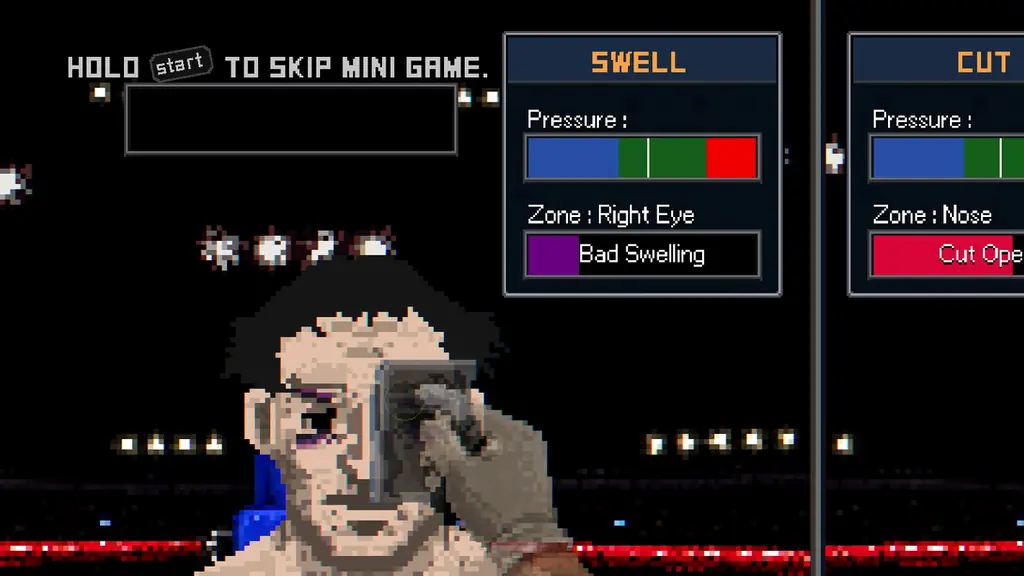
The between-round card shows the fighter's condition by region:
- Head — accumulates damage from every clean shot upstairs; the region that ends fights.
- Ribs — body damage; drains stamina recovery and shows up as a fighter who cannot hold a guard late.
- Arms — damage from blocking and from arm punches.
- Hands — left and right separately, because a broken hand removes half your offence.
- Heart — the warning light. Heart damage is the game's way of telling you a fighter is in real danger, and it comes with its own stoppage risk.
That panel is the honest read on your fighter. Any page that tells you a substance is "free" is wrong: it moves one of these values.
What doping actually gives you
Broadly, three kinds of benefit:
- Recovery — you heal faster between rounds and between fights.
- Conditioning — your stamina bar holds longer under pressure.
- Output — punches land harder or faster for a window.
Each has a corresponding cost. Recovery shortcuts tend to cost the heart warning. Conditioning shortcuts tend to cost later-fight output. Output shortcuts tend to cost accuracy or durability.
The design intent is clear: a doped fighter is trading the end of the career for the middle of it.
Testing
Testing exists and it escalates with your profile. Amateur and low-level pro bouts are lightly overseen; title fights are not.
A positive test can cost:
- the purse,
- a suspension measured in months,
- ranking position,
- and, at the extreme, the licence.
In a game where careers are short, a six-month suspension is a large fraction of your window.
The honest risk assessment
Use it if: you are doing a deliberately short, aggressive career and you accept that the ending may be a medical one.
Do not use it if: you are building toward a title, chasing a specific ending, or playing your first career.
Never use it if: you are already carrying heart damage. That is the one combination that reliably ends a run without a fight.
Cycling off
If you have used and want to stop, the game models the hangover: a period where your numbers are worse than before. Plan for it. Do not schedule a title fight in the first month after stopping.
The practical sequence is: stop, take two easy fights, rebuild, then campaign.
Alternatives that are not cheating
Everything the training system gives you is slower but free of the downside:
- Rest weeks restore recovery.
- Diet affects the same vitals over a longer horizon.
- Corner work manages damage in real time.
- Fight selection avoids the damage in the first place.
A well-managed clean fighter in Bruisers is not weaker than a doped one over a full career. The doped fighter peaks earlier and ends sooner.
For where to buy, read the Darknet. For the damage system itself, see injuries and recovery.
Reading your vitals after a cycle
The vitals panel is the part of the dope system most players ignore, and it is where the cost shows up first.
Heart rate. The most visible marker. A raised resting rate is a signal that the body is under strain, and it is the number the commission looks at when a test is ordered.
Blood pressure. Stacks with weight-cut damage. A fighter who cuts hard and cycles at the same time is asking for a medical suspension.
Energy and form. Short-term performance climbs while the cycle runs, then falls below baseline when it stops. Planning a fight during the trough is how you lose to an opponent you should beat.
Long-term damage. The vitals you damage do not reset between fights the way stamina does. They accumulate across a career, and they follow you into retirement.
The practical habit: check the panel before booking a fight, not after. If two markers are red, take a tune-up instead of a ranked opponent.
FAQ
Do tests happen randomly?
Tests are more likely after high-profile wins and title fights; a raised resting heart rate draws attention.
Can doping be detected before a fight?
Yes, and a positive test can cancel the bout, cost the purse and trigger a suspension.
Do vitals recover fully?
Short-term markers recover with rest; long-term damage accumulates and follows you into retirement.
Sources
More Bruisers 2D Boxing Guides
How the clinch works in Bruisers 2D Boxing: tie-ups, clinch punching, referee breaks, headbutt disqualifications and the in-fighting stance.
Whether Bruisers 2D Boxing is coming to PS5, Xbox or Nintendo Switch, what the store page says, and how likely a console port really is.
How the controls work in Bruisers 2D Boxing: moving, punching high and low, slipping, parrying, clinching and the corner mini-game inputs.
A guide to the between-round corner in Bruisers 2D Boxing: swelling drain, cut repair, tool switching, pressure and how to stop a fight being stopped on you.
How the Darknet works in Bruisers 2D Boxing: buying dope, gear and services off the books, what it costs, and how the risk lands on your fighter.
How defence works in Bruisers 2D Boxing: slipping, parrying, head movement, catching and shooting, and the reads that turn defence into offence.
How the Bruisers 2D Boxing roster works: named opponents, records, divisions, and how to scout a fighter before you sign the contract.
How to play career mode in Bruisers 2D Boxing: building a fighter, booking fights, training camps and making weight.